


 Find additional Shakespeareances
Hamnet
Agnes Power, not Will Power, Carries the Film
Directed by Chloé Zhao
Screenplay by Chloé Zhao and Maggie O'Farrell, based on the novel Hamnet by Maggie O'Farrell
Focus Features, Hera Pictures, Neal Street, Amblin Entertainment, Book of Shadows
Apple TV+, March 28, 2026
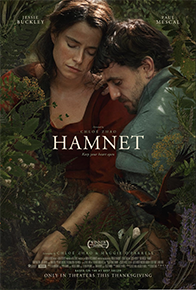 William Shakespeare's most famous speech gets two renderings in the film version of Hamnet based on Maggie O'Farrell's novel of the same name. First is William Shakespeare himself, played by Paul Mescal, standing on the edge of a bridge, staring down into the flood, and contemplating whether to be or not to be. A little later, we see that dread moment of inspiration come to fruition at the Globe theater as the young man playing Hamlet (Noah Jupe) sits on the edge of the stage and contemplates the question of to be or not to be as he looks into the eyes of the groundlings. When he gets to the speech's more sociopsychological debate, Jupe's Hamlet gets to his feet and strolls along the front of the stage, still engaging directly with the audience in the yard, in the the galleries beyond, and the boxes above.
It's the style of direct-address, energetic acting most suitable for playing Shakespeare to today’s audiences as well as to the reportedly demanding and unforgiving Elizabethan audiences. It's a quality of acting Jupe's Hamlet could teach the actor playing the Ghost of his father: Mescal’s William Shakespeare.
This sums up my dueling frustration and fascination with this eight-Oscar-nominated movie, nominations that included Best Picture. Chloé Zhao earned a nomination for her direction, and she and O’Farrell were nominated for their adapted screenplay. Earning nominations for costume (Malgosia Turzanska) and production design (Fiona Crombie and Alice Felton), Hamnet captures the look and feel of Renaissance England, especially in the Stratford-upon-Avon settings and London’s Globe theater. The soundtrack couples Max Richter’s Oscar-nominated score with ever-present winged insects, buzzing bees, and grunting animals to provide a haunting soundscape.
While the film is beautifully shot, and Zhao dynamically captures intimate moments of family life, she also spends excessive film time on drawn-out naval-gazing and speeches searching for profundity. That and her prolonged scene-transition fixation on plants and clouds give Hamnet a torpid pace that dulls its dramatic plot and undermines its historically fascinating characters.
Especially William. This is a Shakespeare who doesn't know how to speak his own texts. We see him coach the young actor playing Hamlet on how to speak the "Get thee to a nunnery scene," getting so frustrated he runs off in psychological crisis to the bridge for his “to be” moment. Shortly after, we watch him on the Globe's stage presenting a constant-pausing, psychologically oppressed, slow-motion performance of the Ghost. Lacking the necessary verse dynamics to make his lines not only engaging but also understandable, Mescal enacts the most boring Ghost I recall ever seeing on stage. He even whispers some of his lines which the audience crushed up to the front of the stage—including his wife—wouldn’t be able to hear, let alone the lords and ladies in the upper tier boxes. I'm surprised those groundlings didn't throw apples at him.
Speaking of apples—I just made a consummation joke there—I'll get to William's family members a little further down. But as this is a Shakespeareances review, let's first address the film's take on this website's namesake.
I watched the film before and after seeing the Royal Shakespeare Company's production of Hamnet, adapted by Lolita Chakrabarti, at the Shakespeare Theatre Company in Washington, D.C. The play and movie are formatively different products. Stage and screen arts may share in the use of actors playing out stories on pretend sets but otherwise are unique art forms. Film has the technology to use many places as a set; theater turns a single set into many places. Theater has no fourth wall, allowing actors and audiences to physically interact; film has a fourth wall called a screen, though Zhao comes close to breaking that fourth wall in the Globe scenes. Cinema plays to audiences watching a past-done production; live theater plays to live audiences watching that day's singularly in-the-moment performances.
These technical differences dictate the approaches to Hamnet each product used. Chakrabarti sculpted a quick-paced play with scene changes carried out by the actors remaining in character, first staged in April 2023 at the Royal Shakespeare Company's Swan Theatre in Stratford-upon-Avon, England. Zhao painted a visual piece of cinematique lingering on images of nature and giving characters a lot of time to think, filmed in the summer of 2024 and released to theaters last August. Play and movie were written for their purposed audiences: Chakrabarti presents Shakespeare theatergoers a psychological thriller; Zhao and O'Farrell concocted a melodramatic portrayal of a famous Renaissance family for cineplex audiences and streamers.
While both versions are centered on the parents' grief over the death of their 11-year-old son, Hamnet, they handle the parental dynamics differently. The movie is a moving experience, with wonderful romantic moments throughout and intense fraught behavior between wife and husband in the wake of their child's agonizing death. Its climactic final 10 minutes played out in the Globe is kind of cheesy but still capable of turning on the eye's spigots. The play explores Agnes's and William's core love more acutely, and its spine-tingling ending wraps up their story in an intimate, revealing conversation providing a quiet but affirming resolution.
The major difference in the measure of quality between the film and the play is their approaches to William. Zhao centers the bulk of her film on the Shakespeare family in Stratford with only glimpses of Shakespeare's London life, emphasizing William's prolonged absences. Chakrabarti's script visits William and his fellow actors rehearsing his earlier plays, a key component of her more dynamic portrayal of "Will/William" without undermining the story's focus on Agnes, aka Anne Hathaway. I've detailed Chakrabarti's rendition and Rory Alexander's stellar performance of it in my review of the stage production (https://www.shakespeareances.com/willpower/nonshakespeare/Hamnet-01-STC26.html). In the movie, William is a shy, out-of-place man who wears his bouts of depression on his sleeve. "Speaking with people is sometimes difficult for me," he tells Agnes in their second meeting. She has him tell her a story instead, and he recounts the mythological tale of Orpheus and Eurydice, a performance that forecasts the kind of actor Shakespeare would become—the real Shakespeare, not Mescal's, who takes the opposite trajectory. Whether intentionally or not, his performance increasingly sheds the stage skills that not only helped Shakespeare write such great plays but also made him a leading actor for his time.
Mescal has many fine, intimate family moments, and his courtship of Agnes is sweetly acted. The scene of his psychological meltdown is authentically portrayed, but perhaps with good reason: reportedly, Mescal purposely got drunk to play the drunk William in that scene. Otherwise, his portrayal of William's depression is two-dimensional and doesn't do the Shakespeare character justice. The more I read Shakespeare, I've come to believe he and I share the secret handshake of people with depression. But like most disabilities, depression is a quality of a person, seldom a defining element. For one thing, it turns many of us into workaholics, which Shakespeare certainly seemed to be. The insecurities that are a byproduct of the condition are success drivers, and the real Shakespeare displayed a lot of courage throughout his playwrighting career. He also became a successful full-time actor and empresario as well, managing a theater company that would become a favorite of England's royal court.
If I seem to be quibbling that Mescal's Shakespeare is not my view of who Shakespeare was, that's because I've seen my view of who Shakespeare was in the stage version of Hamnet, and that version serves the story better. The movie itself further supports my contention in Noah Jupe's performance as Hamlet on the Globe stage. Notably, that performance was filmed in such a way that we, the audience in the cinema or at home, are among the crowd in Shakespeare's theater and Jupe's Hamlet is breaking through cinema's fourth wall. Why couldn't William's Ghost do the same?
While the play does a better job at developing the character of William, the movie does a better job at developing the character of Agnes through flashbacks and those lingering shots in the forest. This includes giving more exposure to her brother, Bartholemew, played in the movie by Joe Alwyn. A simple man, he is in many ways the true heart of the story, having been raised by the same mother who gave birth to Agnes. In the movie, the scenes between brother and sister display more connection and unconditional love than any of the scenes between Agnes and William. Another brilliantly drawn and complex character in both play and film is William's mother, Mary. Played by Royal Shakespeare Company veteran Emily Watson, the movie's Mary gets significantly dramatic screen time with her daughter-in-law. Her evolution from refusing to have Agnes in her house to understanding the depths of Agnes's mothering love—a love strong enough to bring thought-to-be-stillborn Judith to life—is an affecting performance by Watson.
Another notable shared highlight of Hamnet the play and the movie is their casting of the title character. Jacobi Jupe deserved an Oscar nomination for his portrayal of Hamnet. His is an all-out cute little boy, but Jacobi gives a detailed performance throughout, stealing most scenes he's in, even when his mother is present. Climbing into the bed where his pestilence-afflicted twin sister Judith (earnestly played by Olivia Lynes) is experiencing a vision of Death approaching, Hamnet reassures his sister he will keep Death away from her. His face in closeup as is heartbreaking to watch for those of us who know the story's plot. Jacobi's performance of Hamnet's moment of death is also devastating. It merits Agnes's repeated contention to William how Hamnet’s dying isn't the cause of her intense grief but the agony Hamnet suffered in his passing. Jacobi caps his screen time with a nuanced presentation of his afterlife.
Both screen and stage versions use clever visual trickery—natural trickery, not digitally rendered—to "resurrect" Hamnet as Hamlet on the Globe's stage in the final scene. The play uses doubling conventions to carry out the image, a testament to the acting skills of that Hamnet. The movie relies on a different kind of magic: family resemblance. Noah Jupe is Jacobi's older brother, and while the younger Jacobi deserves an Oscar nom, the elder deserves an Olivier nomination for his portrayal of Hamlet at the Globe. Granted, it's not Noah's singular Hamlet that matters to most people watching the movie. The primary point of this brilliant casting is the effect Noah's Hamlet has on Agnes when she sees him walk out on stage for the first time. Agnes's reaction, in my opinion, won the woman playing her the Academy Award's Best Actress Oscar.
Immediately upon watching that, I texted that opinion to my son, an actor who watches almost every movie released. Over our brief textversation, we settled on this timeline: Jessie Buckley sewed up the Oscar nomination when her Agnes gave birth to the twins. She won the award with her scream after Hamnet's last breath. She shut down the Best Actress category when she saw Hamlet walk on stage. The Academy inscribed her name on the statue when she reached out to Hamlet as he was dying on that stage. "It's a performance that really keeps topping herself," my son wrote, and I can't say it any better. Trying to describe how Buckley accomplished such a performance over the course of the 2:05-long movie is beyond the breadth of my wordsmithing capacity. I must note that this in no way casts aspersions on Kemi-Bo Jacobs' stellar Agnes in the play; rather, Buckley, in a performance of such unconstrained honesty, achieved a transcendent piece of character acting that goes to the heart of true art.
It seems trite to say Buckley's performance alone is worth seeing Hamnet the movie. The movie has plenty of qualities to enjoy, despite its overlong stay and William's underwhelming performance as a Ghost. Nevertheless, it is Agnes who lifts the film to stratospheric heights. So, to give a properly Shakespeareances assessment of Buckley's portrayal of Agnes, I'm going to borrow a thought from a character in a play Shakespeare wrote years after his triumphant Hamlet: Caliban in The Tempest. In watching Buckley's Agnes, methought the screen had opened, and I dreamed of such richness of character bestowed into my very soul that when the movie ended, I desired to see it again. And again. And again, right now.Eric Minton
March 30, 2026
For my review of the play Hamnet, click here.
I received my copy of O'Harrell's novel and will post a review of the book In Print when I finish reading it.
Comment: e-mail editorial@shakespeareances.com
Start a discussion in the Bardroom
